
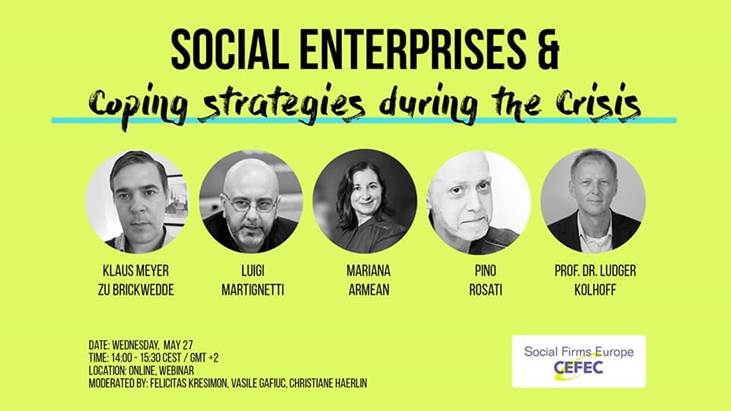
You are invited to: Social Enterprises & Coping Strategies During the Crisis
Date: Wednesday, May 27 Time: 14:00 – 15:30 CEST / GMT +2 Location: Online / live webinar
Register by clicking on this link
————————————————————————————————————————–
Why now? The current crisis has highlighted different elements of fragility as well as the potentiality of social economy and enterprise strategies or tools, developed to create a system of stronger democracy, inclusion and justice – especially in the field of work – characterized by quality and long-term sustainability.
What to expect? The intention of this occasion is to get inspired by information and examples in which these characteristics are used to face the crisis. Furthermore, we want to give innovative inputs, aimed at supporting the changes necessary to achieve our objectives of a more equal, green, accessible and inclusive society for all, including people with vulnerability.
Main topics #1. Green economy (Pino Rosati) #2. Digital tools during and after the crisis (Prof. Dr L. Kolhoff) #3. Mental health (Mariana Armean) #4. Social firms for inclusion (Klaus Meyer zu Brickwedde) #5. Europe and social enterprises (Luigi Martignetti)
The event will be moderated by: – Felicitas Kresimon, SFE CEFEC Deve Manager / Italy – Vasi Gafiuc, SFE CEFEC General Secretary/ Romania – Christiane Haerlin, SFE CEFEC President 2019/2020 / Germany
You can find below the complete description for each of the sessions. _________________________________________
#1 GREEN ECONOMY
“Nobody saves themselves – Cooperation between cooperatives”, Cooperativa Sociale LISTER, Trieste, Italy, Pino Rosato
Pino Rosati is the Creative Director and head of the board of the Social Cooperative type B, LISTER Social Tailoring. LISTER is located in the Cultural Park San Giovanni (ex psychiatric hospital) in Trieste and the main activities of work inclusion for people from vulnerable groups, are the collection and reworking of disused garments and textile materials for the production of clothing accessories. _________________________________________
#2 DIGITAL TOOLS DURING AND AFTER THE CRISIS
“Digital educational offers for people with disabilities”, University Ostfalia, Germany, Prof. Dr. L. Kolhoff
Prof. Dr. Ludger Kolhoff is the author of publications in the field of Social economy and offers courses and master classes on business start-up and entrepreneurship in the social economy With about 13,000 students, twelve faculties, and 21 departments, Ostfalia counts among the biggest universities of applied sciences in Lower Saxony, promotes and supports an important variety of international research and support of start-up activities. _________________________________________
#3 MENTAL HEALTH
“Mental Health on pandemic crises”, Estuar Foundation, Mariana Armean
Mariana Armean is the programs Director of the Estuar Foundation, clinical psychologist with 25 years of expertise in mental health, certified psychotherapist by the International Society of Schema Therapy, International trainer for Specialists and Practitioners in Social and Psychiatric Work, trained and accredited by University of Applied Sciences, Dornbirn, Austria.
_________________________________________
#4 SOCIAL FIRMS FOR INCLUSION
“Situation of Inclusive Enterprises in Germany during the Corona crisis”, bag if, Klaus Meyer zu Brickwedde
Klaus Meyer zu Brickwedde is a consultant for Bundesarbeitsgemeinschaft Inklusionsfirmen (bag if). “bag if” is the federal association of inclusive enterprises in Germany. It represents the interests of more than 900 inclusive enterprises and over 29,000 employees.
_________________________________________
#5 EUROPE AND SOCIAL ENTERPRISES
“2021-2027: what should we expect for social economy enterprises?”, REVES, Luigi Martignetti
Luigi Martignetti is the Secretary General of the European Network of Cities and Regions for the Social Economy – REVES. REVES is the unique EU network that brings together regional and local public authorities in partnership with respective social economy organizations. For more than 25 years REVES seeks collaboration with EU institutions in order to improve the ecosystem for social, sustainable and responsible local economies. REVES was a founding member of Social Economy Europe.
